


Sportswear Manufacturer Buyer’s Guide 2025: Fabrics, MOQ, Pricing & Timelines

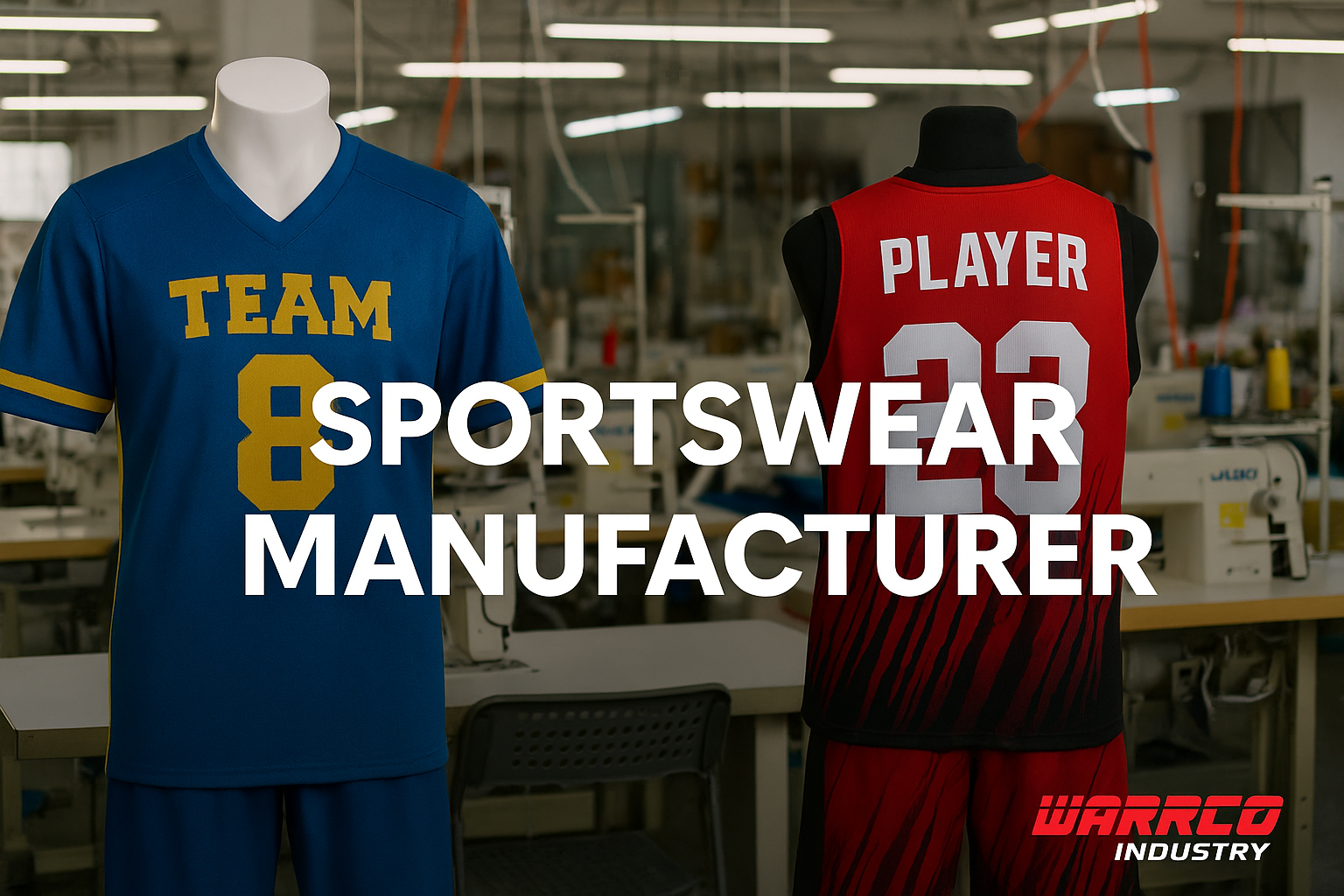
Creating a successful sportswear line in 2025 isn’t about luck — it’s about smart planning, attention to detail, and choosing the right factory partner.
This guide breaks down everything a Sportswear Manufacturer looks for — from fabrics and MOQ to pricing and production timelines — so your next collection runs smoothly.
Whether you’re a new brand in the UK, Germany/EU, or the USA, or scaling an existing label, this article will help you navigate the manufacturing process with a Sialkot-based OEM Production Company or Original Equipment Manufacturer (OEM).
1. Understanding the Right Manufacturing Model: OEM vs ODM vs OBM
Choosing your manufacturing model sets the tone for your entire project.
- OEM (Original Equipment Manufacturer) – You bring your designs, specs, and branding; the factory engineers and produces your garments exactly as you envision. Ideal for brands that want custom fits, performance fabrics, and unique prints.
- ODM (Original Design Manufacturer) – The manufacturer offers pre-made styles that you can rebrand. It’s faster and usually more cost-efficient, though customization is limited.
- OBM (Own Brand Manufacturer) – The factory produces and sells its own branded products; you simply buy them wholesale.
👉 For true creative control — from materials to labeling — work with an experienced OEM Production Company that specializes in OEM in Apparel.
2) Fabric Choices That Make or Break Performance
Think of fabric as the engine under the hood. Choose it first — everything else follows.
How to decide:
- Match fabric to use case.
- Breathable team jerseys → polyester or recycled polyester.
- High‑stretch bottoms → nylon/spandex or poly/spandex.
- Cool‑weather layers → brushed back polyester or fleece.
- Test the weight (GSM — grams per square meter).
- Training tees often live around 160–220 GSM.
- Leggings typically 220–300 GSM depending on opacity and compression.
- Check compliance for Europe.
Ask for OEKO‑TEX® options and REACH‑aligned inputs when shipping to the EU/UK. - Run quick trials.
Wash, stretch/recovery, pilling, and colorfastness (sweat/wash/rub).
3) Decoration & Branding: Pick the Right Method
The decoration technique you choose shapes both the look and durability of your sportswear.
- Sublimation: Ink becomes part of the polyester fibers — perfect for colorful, all-over team graphics.
- Screen Printing: Durable and bold, ideal for large solid designs.
- DTF (Direct-to-Film): Great detail, flexible for small or mid-sized runs.
- Embroidery: Premium, textured finish; perfect for crests and logos.
- Heat Transfer/Vinyl: Quick customization for player names or numbers.
Pro tip: Match the method to your fabric and design complexity — for example, sublimation for light poly jerseys and embroidery for cotton-blend jackets.
4. Understanding MOQ in 2025 (and How to Keep It Manageable)
MOQ (Minimum Order Quantity) can make or break your production plan.
Here’s what most Custom Clothing Manufacturers expect today:
- Standard MOQ: 100–300 units per style/color for OEM sportswear.
- When MOQs increase: Custom-dyed fabrics, unique knits, or complex embellishments.
- Reorders: If your fabric is in stock, you can often repeat styles at 50–100 units.
Tips for friendly MOQs:
- Start with fewer colorways.
- Use the same base fabric for multiple styles.
- Choose stock fabrics and trims initially.
- Create a repeatable base design (same fit, different prints).
5. What Actually Drives Your Price (and How to Negotiate)
Pricing isn’t random — every decision you make influences it. Here’s what affects your unit cost with any Apparel Manufacturer or Custom Clothing Manufacturer:
- Fabric and trims: Fiber type, GSM, finishes, and accessories.
- Pattern complexity: More panels and stitching equal higher labor time.
- Printing and embellishments: Larger, multicolor, or detailed prints cost more.
- Order size: Bigger quantities lower your per-unit cost.
- Packaging: Custom labels, tags, and boxes add up quickly.
- Shipping terms (Incoterms):
- EXW: You handle shipping from the factory.
- FOB: Factory delivers to port; you manage freight.
- CIF: Factory pays freight to your port.
- DDP: Factory delivers to your door — includes duties and taxes.
💡 Example: A performance T-shirt (170 GSM, chest print only) might cost $8–$15 FOB. All-over sublimation or heavier fabric can increase price, while larger orders reduce it.
Negotiation tips:
Simplify panels, consolidate colors, and ask for tiered pricing (200 / 300 / 500 pcs) to compare savings.
6. How the Sportswear Manufacturing Process Flows
Here’s a realistic timeline from design to delivery when working with a Sportswear Manufacturer:
- Design & Tech Pack: 1–2 weeks
Define measurements, colors (Pantone), and label artwork. - Sampling: 2–3 weeks
Prototype → size set → PP (Pre-Production) sample. - Bulk Production: 4–8 weeks
Cutting, printing, stitching, finishing, and packing. - Quality Control: 1 week
Inspections follow AQL (Acceptable Quality Limit) standards. - Shipping: 1–6 weeks
Air freight for speed; sea freight for cost savings. Most EU/UK buyers now prefer DDP (Delivered Duty Paid).
⏳ Plan for roughly 12–14 weeks from tech pack to delivery on your first order. Reorders can be as fast as 6–8 weeks.
7. Key Agreements to Finalize Before You Order
Avoid misunderstandings by aligning these points early with your Sportswear Manufacturer:
- Incoterms: Confirm EXW, FOB, CIF, or DDP before production starts.
- Specs & samples: Approve the final Tech Pack and keep a sealed PP sample as the standard reference.
- Quality level: Define AQL expectations; use third-party QC if required.
- Compliance & labeling: Ensure care labels, fiber content, and COO (Country of Origin) meet REACH/OEKO-TEX® standards.
- Color consistency: Approve lab dips and strike-offs using Pantone references.
- Timeline milestones: Set and confirm key dates — sample approval, bulk start, and shipping.
- Reorder readiness: Note fabric lot, GSM, and trim codes for fast repeat runs.
8. Compliance for UK/EU: What You Must Know
If you’re selling into the UK or EU, compliance is non-negotiable.
- Get an EORI (Economic Operators Registration and Identification) number.
- Use REACH-compliant materials and request OEKO-TEX® certificates where possible.
- Double-check care labels and fiber content before shipping to avoid re-labelling costs.
9. Your First-Order Checklist
Before confirming your first PO (Purchase Order), tick off these essentials:
- Tech pack finalized and approved.
- Fabric chosen with GSM and test results.
- Printing method and strike-off approved.
- MOQ and pricing confirmed with multiple quantity options.
- Incoterm selected (EXW/FOB/CIF/DDP) and duties defined.
- PP sample approved and sealed.
- AQL level agreed; QC schedule set.
- Production and shipping timeline confirmed.
- Reorder documentation (fabric, trims, PP sample ID) recorded.
10. Why Many Global Brands Choose Sialkot
Sialkot, Pakistan has long been a hub for team sportswear and gym wear production. Local factories are known for:
- Fast and flexible sampling.
- Lower MOQs compared to other regions.
- Skilled craftsmanship and embellishment expertise.
- Easy compliance with REACH and OEKO-TEX® for Europe.
- Competitive pricing and export-ready documentation.
Working with a Clothing Manufacturer in Sialkot means efficiency, flexibility, and access to decades of technical know-how.
11. Sample Email Template to Request a Quote
Subject: RFQ – Team Jersey + Training Tee (OEM) – UK/EU
Hi Team,
We’re sourcing an Original Equipment Manufacturer / OEM Production Company for two sportswear styles.
• Fabric: 170–180 GSM polyester (OEKO-TEX® preferred)
• Print: Sublimation (jersey) + small screen print (tee)
• Quantity: 200 / 300 / 500 pcs per style and color
• Terms: Please quote FOB and DDP [City, Country]
• Timeline: PP sample by [date], ex-factory by [date]
• Attachments: Tech packs, size chart, Pantone codes
Please include a cost breakdown (fabric, make, print, packaging) and confirm AQL and lead times.
Best regards,
[Your Name]
Final Thoughts
Working with the right Sportswear Manufacturer can transform your business.
Pick the right fabrics, plan realistic MOQ and timelines, understand your pricing levers, and secure all key terms early.
If you’re looking for a trusted Apparel Manufacturer or Custom Clothing Manufacturer that caters to brands across the UK, Germany/EU, and USA, partner with an experienced Original Equipment Manufacturer who can bring your vision to life — from concept to shipment.