


NFHS Authenticating Mark Program: The #1 Essential Guide for US Sports Brands

If you sell sports equipment or uniforms into the US high school market, you’ve probably run into this at some point: a school athletic department orders your product, then comes back asking if it’s “NFHS approved.” And if you’re not totally sure what that means, or how you’d actually get there, you’re far from alone. It’s one of those terms that gets thrown around constantly in team sports procurement and explained clearly almost nowhere.
So let’s fix that. This guide walks through the NFHS Authenticating Mark, the NFHS Approval Process step by step, and where it fits alongside the separate (and often confused) world of NFHS uniform rules. If you’re a brand trying to get real traction in US school sports — or trying to sell into Europe where compliance expectations are just as picky — this should save you a lot of back-and-forth with confused customers.
What Is the NFHS, and Why Does It Matter to Your Brand?
The National Federation of State High School Associations (NFHS) is the governing body that writes the playing rules for high school sports across the US. More than 19,000 high schools nationwide follow NFHS rules, covering roughly 8 million student-athletes. That’s not a niche market — that’s one of the largest organized sports markets in the country, and it runs almost entirely on NFHS standards.
Here’s why that matters to you as a manufacturer or brand: schools and athletic associations generally won’t use equipment in official competition unless it meets NFHS specifications. If your soccer balls, basketballs, or team uniforms aren’t compliant, they simply don’t get used in sanctioned games — no matter how good the product is. That’s the whole reason the Authenticating Mark exists.
What Is the NFHS Authenticating Mark Program (AMP)?
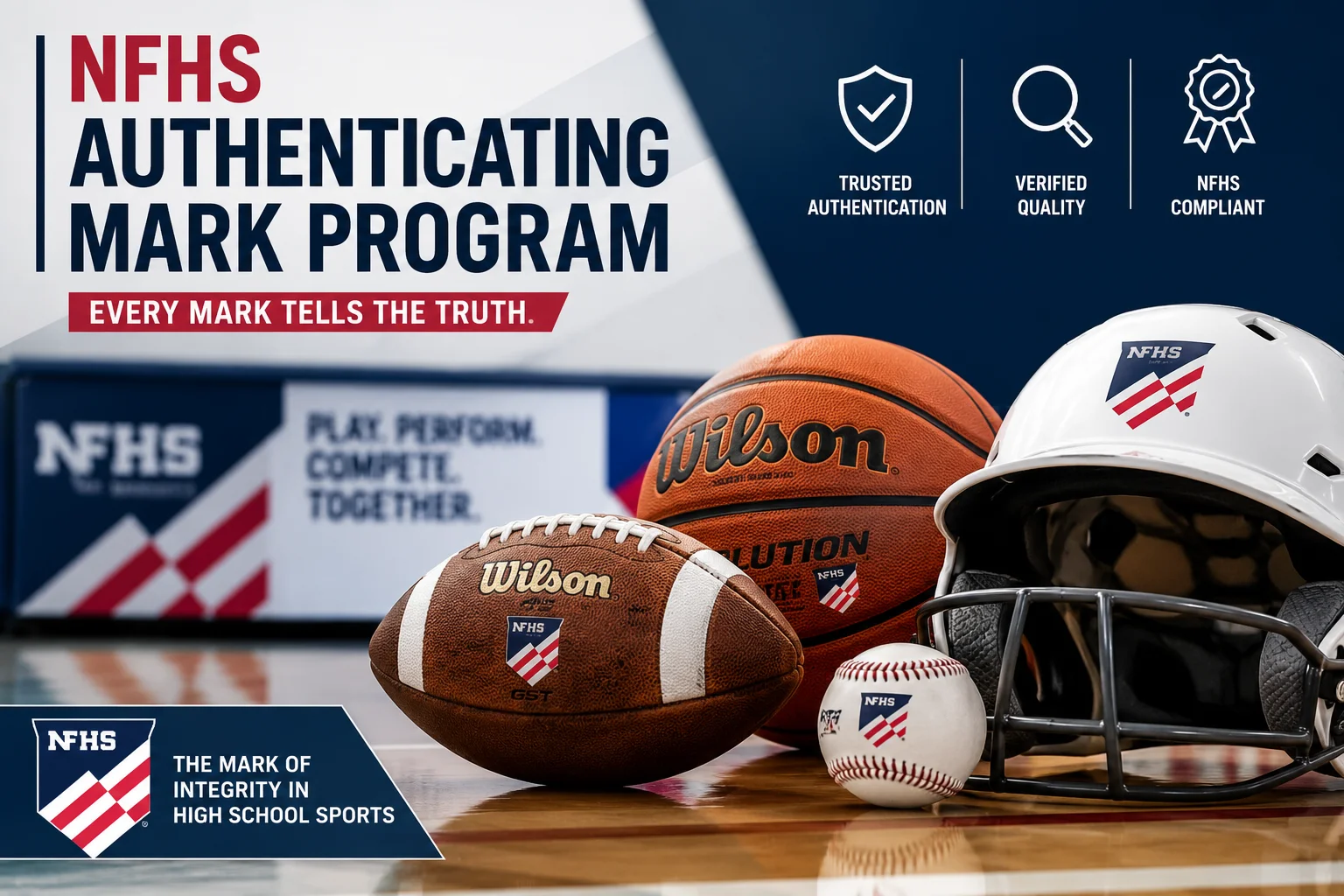
The Authenticating Mark Program, usually just called AMP, is NFHS’s official certification system for equipment used in interscholastic competition — most commonly balls and pucks. The purpose is straightforward: make sure the equipment schools are using actually meets NFHS specifications, so every team is competing on genuinely equal footing.
The program has been running since the 2000-01 school year and is currently administered by LRG Prep on behalf of NFHS. Once a manufacturer completes the process, their product carries the official NFHS mark, which tells athletic directors and coaches — instantly — that the product is cleared for use in official play. Major manufacturers including Wilson, Nike, Russell, Rawlings, Baden Sports, and Mikasa have gone through this process for various products over the years.
The NFHS Approval Process, Step by Step
This is the part most brands actually want to understand, so here’s the real breakdown. The NFHS approval process runs through six phases:
- Application. You start by submitting a formal application to the program administrator, identifying the specific product you want authenticated.
- License agreement. Once your application is accepted, you sign a licensing agreement with NFHS, which sets out the terms for using the Authenticating Mark on your product.
- Product testing. Your product gets sent to a qualified, independent testing laboratory — one that meets recognized industry standards — to verify it meets NFHS specifications for that sport and equipment type.
- Artwork approvals. The way the mark itself is displayed on your product and packaging has to be approved. NFHS is particular about how its mark is reproduced, sized, and positioned, so this step isn’t just a formality.
- Finished samples. You submit finished, production-ready samples for final review, confirming that what you’re actually shipping matches what was tested and approved.
- Product authentication. Once everything checks out, your product is officially authenticated and cleared to carry the NFHS mark.
It’s not an overnight process, and it’s not free — there are licensing fees involved, and manufacturers should expect ongoing costs tied to usage, not just a one-time application charge. Exact current fees are best confirmed directly with NFHS or LRG Prep, since program terms do get revised over time. But budgeting for both an upfront cost and an ongoing royalty structure is the realistic way to plan for this.
What the Authenticating Mark Actually Covers
Here’s something that trips a lot of brands up: the Authenticating Mark Program, in its classic form, was built primarily for balls and pucks — think soccer balls, basketballs, footballs, volleyballs, and hockey pucks. If you’re manufacturing sporting goods in that category, this is the exact program you need to go through.
Uniforms are a different story, and it’s worth understanding the distinction clearly before you tell a customer your team wear is “NFHS approved,” because that phrase means something specific.
NFHS Rules for High School Sports Uniforms
Uniforms don’t go through the Authenticating Mark Program the way balls and pucks do. Instead, NFHS publishes detailed uniform specifications inside its individual sport rule books — covering things like jersey color contrast, number size and placement, legal number combinations, and how much logo or trim space is allowed.
Basketball is a good example of how specific this gets. NFHS rules dictate legal jersey numbers (only certain digit combinations are allowed), minimum number height on the front and back, how many colors can appear in a number, and — as of the 2024-25 season — a rule that jersey numbers can no longer match the jersey’s own fabric color, since officials found that made numbers too hard to read from a distance. Football and soccer have their own detailed versions of the same idea: contrast requirements, number sizing, and limits on logo size.
On top of the rule-book requirements, NFHS also maintains a separate Uniform Design Approval Mark that manufacturers can use to indicate a uniform design has been reviewed against NFHS specifications. That’s a distinct process from the AMP ball/puck certification — worth knowing if a school ever asks specifically about “uniform design approval” rather than “authenticating mark.”
This is where high school sports uniforms and US athletic compliance actually come together in practice — get the color contrast wrong, use an illegal number style, or oversize a logo, and a team can be flagged for an illegal uniform mid-season. That’s an expensive mistake for a brand to be responsible for, and it’s entirely avoidable with the right production process.
Sublimation Team Wear and Compliance
Sublimation is the dominant production method for custom team uniforms these days, and for good reason — it lets you print full-color designs, numbers, and names directly into the fabric fibers instead of layering material on top, which means no cracking, peeling, or fading the way heat-transfer vinyl can over a season of wash cycles.
But sublimation also makes NFHS compliance easier to control, not harder — since the numbers and colors are digitally set before production, a manufacturer who actually checks NFHS number-size and contrast rules against the design file before printing can catch a compliance issue before a single jersey gets made, instead of after 200 units are already printed and a coach is asking why the numbers got flagged.
US Athletic Compliance Beyond the AMP
The Authenticating Mark and uniform rules are the two most sport-specific compliance pieces, but they’re not the whole picture. Brands selling into the US and European team sports markets should also be thinking about general product safety standards, labeling requirements, and — depending on the product — flammability and material safety testing, especially for anything marketed toward youth athletes.
None of this is meant to sound intimidating. It’s genuinely manageable once you understand which requirements apply to which product category, and a manufacturer who’s done this before can walk you through it in a fraction of the time it takes to figure it out alone.
Common Mistakes Brands Make Around NFHS Compliance
Calling a uniform “NFHS approved” when what they actually mean is that it was made with NFHS rule specs in mind — these are different claims, and the wrong one can get flagged by a school district that checks closely.
Assuming a certified ball supplier automatically means the uniforms are compliant too — they’re two entirely separate certification tracks with separate requirements.
Skipping a compliance check on jersey numbers and colors before bulk sublimation printing, then discovering an entire order is technically illegal for competition after it’s already been produced.
Not budgeting for the ongoing licensing costs of the Authenticating Mark, and getting caught off guard by royalty terms after committing to the process.
Assuming NFHS rules stay static — they don’t. The 2024-25 basketball number-color change is a good example of how these rules get updated, and a manufacturer who isn’t tracking rule revisions can end up producing uniforms that were compliant last season but aren’t anymore.
Why This Matters When Choosing a Manufacturing Partner
Getting a product genuinely ready for the US school sports market — whether that’s an authenticated ball or a fully compliant sublimated uniform — takes a manufacturer who actually understands the difference between these programs and stays current on rule changes. It’s not something you want to be figuring out for the first time after a customer complaint.
At Warrco Industry, our team builds sublimated team wear with current NFHS uniform specifications checked at the design stage, not after production — the same attention to detail we bring to sourcing the trims and hardware that go into every garment we make. If you’re planning to pursue Authenticating Mark certification for equipment, we can also help align your production process so testing and finished samples go smoothly the first time.
If you want a manufacturing partner who won’t leave you guessing about US athletic compliance, reach out to Warrco Industry and let’s talk through what your specific product needs.
Frequently Asked Questions
What are the NFHS rules?
NFHS rules are the official playing rules for high school sports in the US, covering everything from gameplay to equipment and uniform specifications — jersey colors, legal numbers, logo size limits, and required protective gear. Each sport has its own detailed rule book, published and updated by the National Federation of State High School Associations, and individual state athletic associations enforce these rules at the school level.
What soccer balls are NFHS approved?
An NFHS-approved soccer ball is one that has gone through the Authenticating Mark Program — tested by an independent lab against NFHS specifications and licensed to carry the official mark. Major sporting goods brands including Wilson, Baden Sports, and other AMP-participating manufacturers produce NFHS-authenticated soccer balls; schools and officials can typically verify a specific ball model’s status directly through NFHS’s authentication records before ordering.
Is the NFHS Authenticating Mark the same as NFHS uniform approval?
No, and this is a common point of confusion. The Authenticating Mark Program (AMP) certifies balls and pucks. Uniforms are governed separately by rule-book specifications for each sport (covering colors, numbers, and trim) and a distinct NFHS Uniform Design Approval Mark. A brand can be fully compliant on one track and not the other, so it’s worth confirming exactly which certification a customer is asking about.
Does every high school sports product need NFHS certification?
Not every product category goes through formal AMP certification — it applies mainly to balls and pucks used in official competition. Uniforms, protective gear, and other equipment instead need to comply with the specific rule-book requirements for that sport, which is a different (though related) compliance path.
How long does the NFHS approval process take?
Timelines vary by product and testing lab availability, but between application, independent lab testing, artwork approval, and finished sample review, brands should generally plan for a multi-month process rather than a quick turnaround. Building this timeline into your product launch planning early avoids scrambling later.
Ready to Build Compliant Team Wear Without the Guesswork?
Between the Authenticating Mark Program, sport-specific uniform rules, and general US athletic compliance standards, there’s a lot for a growing sports brand to track — and getting it wrong after production is a lot more expensive than getting it right before. Warrco Industry builds NFHS-aware sublimated team wear and works with brands pursuing AMP certification for equipment, so you’re not navigating this alone.
Talk to Warrco Industry about your next team wear or sporting goods production run, and let’s build it right the first time.