


Essential Trims and Accessories in Apparel Manufacturing: Complete Buyer’s Guide

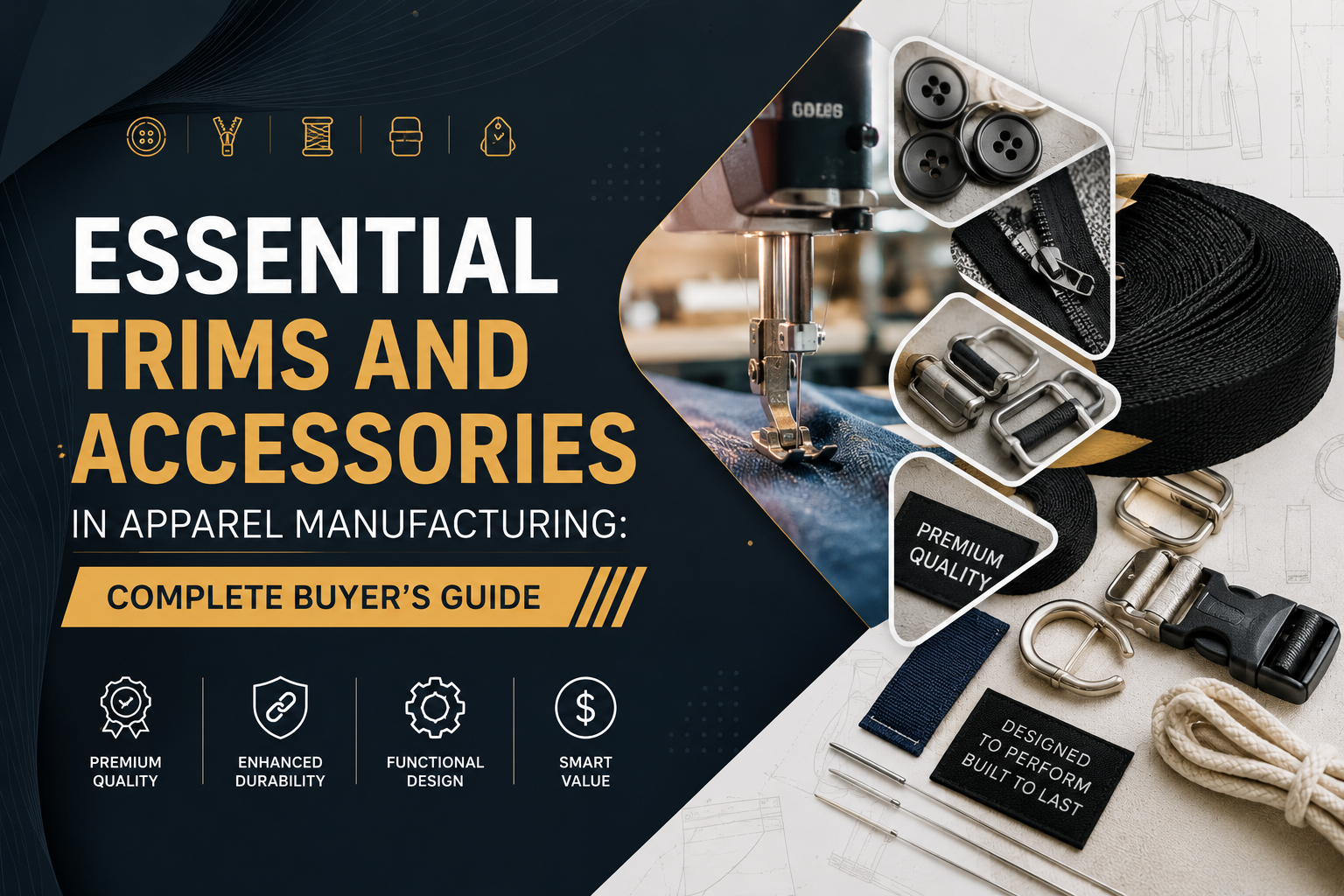
Picture this: your garment sample looks perfect. Fabric’s right, stitching’s clean, fit is dialed in. Then it ships to a customer, and the zipper jams on the third use. Or the buttons start falling off after two washes. The fabric wasn’t the problem — the trims were.
It happens more than people admit. Brand owners spend weeks obsessing over fabric quality and almost no time thinking about the small parts holding the garment together and giving it its finished look. And then those small parts are exactly what breaks first.
This guide is about apparel manufacturing trims — what they are, the main types of clothing trims you’ll actually deal with, and how to pick the right ones instead of leaving it to chance. Whether you’re sourcing your first production run or trying to figure out why your last batch had a 15% return rate, this should clear things up.
What Are Trims and Accessories, Exactly?
Trims and accessories are everything added to a garment beyond the main fabric — zippers, buttons, lace, labels, drawstrings, elastic, interlining, hang tags, and so on. Some of it’s functional (a zipper needs to actually zip), some of it’s decorative (sequins don’t hold anything together; they just look good), and a lot of it does both at once.
Here’s the thing nobody tells new brand owners: trims can make up a surprisingly large chunk of your per-unit cost, and an even bigger chunk of your defect rate. A cheap zipper doesn’t just look cheap — it fails, and when it fails, that’s a return, a bad review, or a customer who never orders from you again. Fabric gets all the attention in sourcing conversations. Trims are usually where the actual problems hide.
Why Trims Deserve More Attention Than They Get
If you’ve ever wondered why one factory’s t-shirts feel noticeably more “finished” than another’s, even with similar fabric, the answer is almost always in the trims. Good hardware, clean stitching around a zipper, buttons that sit flush and don’t wobble these are the details that make a garment feel premium instead of cheap, and customers notice, even if they couldn’t tell you why.
There’s also a compliance angle, especially if you’re selling into the US or Europe. Certain trims — nickel-heavy buttons, specific dyes, flammable components in kidswear can run into regulatory trouble depending on the market. A trim that’s fine in one country can get your shipment flagged in another. It’s worth knowing this before your container is sitting at customs.
The Main Types of Clothing Trims You’ll Actually Work With
Let’s go through the categories that matter most, one at a time.
High-Quality Zippers
Zippers are probably the single most failure-prone trim in the entire garment, which is exactly why “high-quality zippers” isn’t just marketing language — it’s a real spec you should be checking. A zipper has to survive hundreds of open-close cycles without the teeth misaligning, the slider jamming, or the pull tab snapping off.
There are a few things worth knowing here. Metal zippers (YKK is the industry benchmark most experienced brands ask for by name) tend to hold up better on denim and outerwear. Plastic or nylon coil zippers work fine for lighter garments and are cheaper, but not all coil zippers are equal — cheap ones split under tension. If your garment is going to see real wear (jackets, bags, workwear), don’t cut corners here. It’s one of the few trims where the price difference between “fine” and “good” is small, but the difference in customer complaints is huge.
Custom Buttons
Buttons seem simple until you’re the one dealing with a customer complaint about one falling off in the wash. Beyond just looking right, buttons need to be attached with proper thread tension and reinforced stitching, especially on garments that get thrown in a washer and dryer repeatedly.
Custom buttons — branded with a logo, made from a specific material like horn, wood, or metal — are also a legitimate branding tool. A well-designed custom button on a jacket or a pair of jeans becomes part of your brand identity, not just a functional part. If you’re building a brand people remember, this is a cheap upgrade with a disproportionately large visual payoff.
Apparel Lace & Sequins
These sit firmly in the decorative category, and they’re where a lot of women’s wear and eveningwear brands actually differentiate themselves. Lace trims add texture and detail to necklines, hems, and sleeves. Sequins add shine and movement, but they’re also one of the trickier trims to work with from a production standpoint, because poorly attached sequins shed, and nobody wants a dress that leaves a glitter trail everywhere it goes.
If you’re using lace or sequins, ask your manufacturer how they’re securing them. Hand-stitched, machine-embroidered, or heat-bonded all hold up differently, and the cheapest method isn’t always the one that survives a customer actually wearing the garment more than once.
Garment Accessories
This is the catch-all category: labels, hang tags, drawstrings, elastic, care labels, size tags, packaging inserts. It’s easy to treat these as an afterthought, but they’re often the first physical thing a customer touches when they open the package, and first impressions matter more than people give them credit for.
A woven label feels more premium than a printed one. A well-designed hang tag can justify a higher price point before the customer’s even seen the garment properly. On the functional side, drawstrings and elastic need to hold tension without stretching out after a few wears — a hoodie drawstring that goes limp after a month is a small thing that quietly damages trust in your brand.
Hardware Trims
Hardware trims cover metal or plastic components like rivets, snap buttons, D-rings, buckles, eyelets, and grommets. You’ll see these most on denim, outerwear, bags, and workwear. They’re functional first, decorative second — a rivet on a jean pocket is reinforcing a stress point, not just there for looks.
The failure mode with hardware is usually corrosion or breakage, especially with cheaper plated metal that looks fine in the sample but rusts after a few washes or a season of actual wear. If your garment is aimed at markets with humid climates or heavy washing habits, this is worth specifically testing before you commit to a bulk order.
How to Actually Choose the Right Trims for Your Garment
A few practical filters that cut through most of the guesswork:
Match the trim to how the garment will actually be used. A zipper on a light summer jacket doesn’t need the same durability as one on a work jacket that’s getting used daily. Overspending on unnecessary durability wastes money; underspending on a garment that gets heavy use creates returns.
Test before you commit to bulk. Wash tests, wear tests, and stress tests on trims are cheap compared to the cost of a bulk order full of buttons that crack or zippers that jam. This is a five-minute conversation with your manufacturer that can save you thousands of dollars.
Ask what compliance testing has been done, especially for kidswear or anything selling into the US and EU. Lead content in metal trims, flammability of decorative elements, and choking-hazard rules for small parts on children’s clothing are all things regulators actually check.
Don’t treat trims as an afterthought in your budget. If fabric eats 70% of your attention and trims get whatever’s left, you’ll end up with beautiful fabric attached to hardware that fails first. Budget for trims as they matter, because they do.
Common Mistakes Brands Make With Trims
Choosing the cheapest zipper available without testing it, then discovering the failure rate only after a few hundred returns start coming in.
Skipping wash and wear testing entirely and assuming “it looked fine in the sample” is enough — samples get handled gently; real customers don’t.
Ignoring compliance requirements for the market they’re selling into, and getting a shipment flagged or rejected at customs because of a trim nobody thought to check.
Treating decorative trims like lace and sequins as pure aesthetics, without asking how they’re actually attached — and ending up with a product that sheds or falls apart after light use.
Not budgeting properly for trims, then being surprised when “premium fabric, cheap trims” ends up feeling like neither.
Why This Matters When Choosing a Manufacturing Partner
Sourcing trims well takes relationships — with reliable zipper suppliers, button makers who can actually hit custom specs, and hardware vendors who don’t cut corners on plating. A manufacturer without those relationships either passes on inflated costs or quietly substitutes cheaper components without telling you.
At Warrco Industry, trims and accessories go through the same scrutiny as fabric — sourced from vetted suppliers, wash and wear tested before bulk production, and checked against the compliance standards relevant to whatever market you’re shipping into, whether that’s the US or the EU. It’s part of the same process our team follows across every stage of production — you can read more about how the full garment production team works together if you want the bigger picture.
If your last production run had trims that let the whole garment down, or you don’t want to find out the hard way, get in touch with Warrco Industry and let’s talk trims before they become a problem.
Frequently Asked Questions
What are the main types of clothing trims used in garment manufacturing?
The main categories are functional trims like zippers, buttons, and hardware (rivets, snaps, buckles); decorative trims like lace, sequins, and embroidery; and garment accessories like labels, hang tags, drawstrings, and elastic. Most garments use a combination of all three, depending on the style and end use.
What’s the difference between trims and accessories in garments?
“Trims” usually refers to components directly attached to the garment during construction — zippers, buttons, lace, hardware. “Accessories” often refers to items added during finishing or packaging — labels, hang tags, poly bags, size stickers. In practice, the industry uses both terms fairly interchangeably, and most sourcing guides group them.
Why do zippers and buttons fail so often after a few washes?
Usually it comes down to cheap materials or poor attachment — insufficient stitch reinforcement around buttons, low-grade metal or plastic in zippers that doesn’t hold up to repeated stress, or skipping wash testing before bulk production. A trim that looks fine in a single sample can fail after ten wash cycles if it wasn’t properly tested.
Where can I find a full list of garment trims and accessories?
Most sourcing guides and textile resources break trims down by function: sewing trims (thread, interlining), closures (zippers, buttons, snaps, hooks), decorative trims (lace, sequins, embroidery, appliqué), and accessories (labels, tags, drawstrings, elastic, packaging). A reliable manufacturer should be able to walk you through exactly which categories apply to your specific garment.
How does the trims and accessories department work in a garment factory?
The trims and accessories department sources, receives, inspects, and issues trims to production lines as needed. They track inventory against order requirements, verify trims meet approved specifications before they reach the sewing floor, and coordinate with quality control to flag any defective batches before they’re used in bulk production.
Ready to Stop Losing Sales to Bad Trims?
Fabric gets the spotlight, but trims are usually where quality quietly breaks down — a zipper that jams, a button that falls off, hardware that rusts after one season. Getting this right isn’t complicated; it just needs to be taken seriously from the start. Warrco Industry sources, tests, and quality-checks every trim that goes into your garments, so the small parts hold up as well as the fabric does.
Talk to Warrco Industry about your next production run, and let’s make sure your trims don’t undo everything else you got right.