


Who Does What in Clothing Production? Key Roles in Apparel Manufacturing

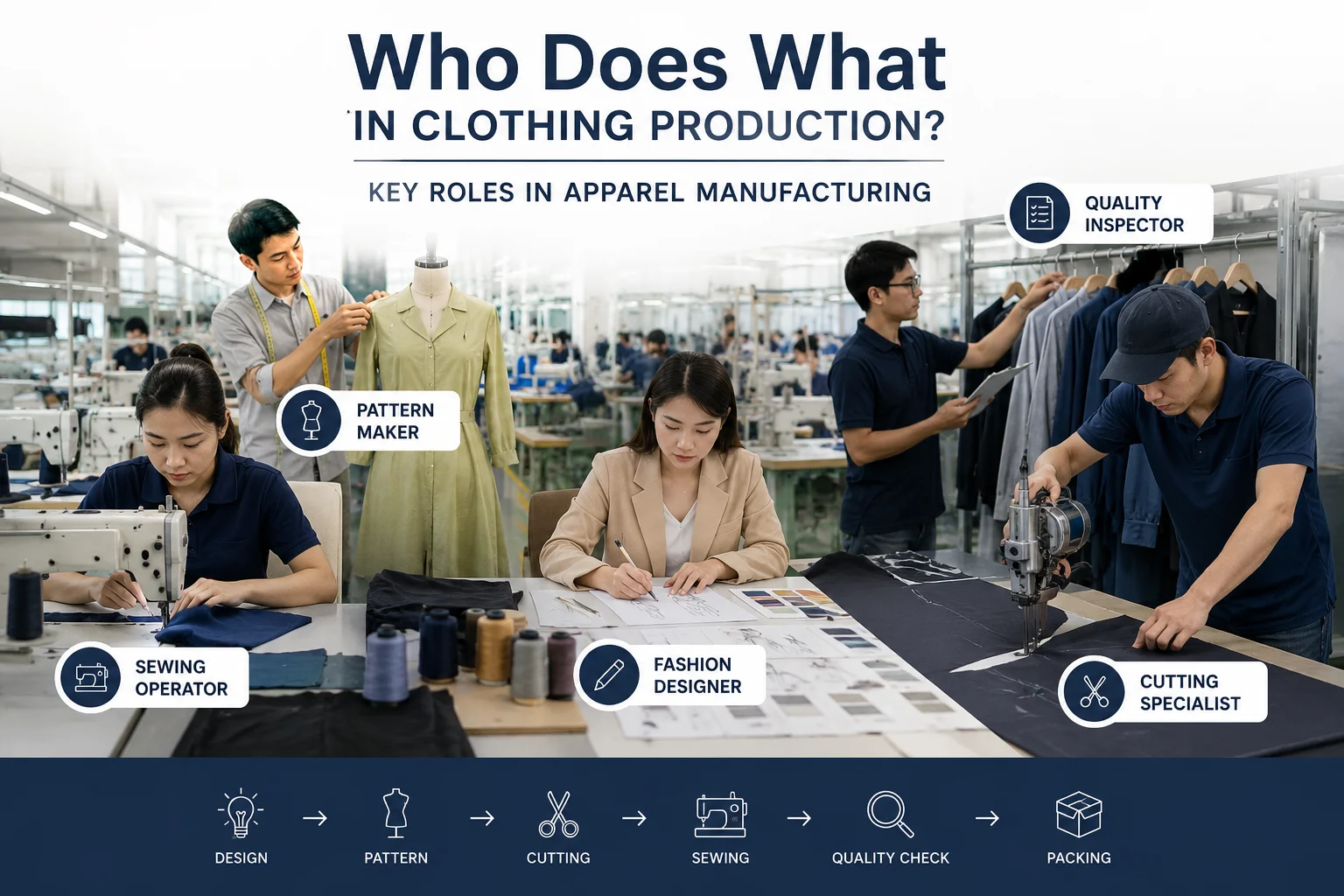
Here’s a scenario a lot of new brand owners go through. You’ve nailed the design. The fabric swatch feels amazing in your hand. You place your first bulk order, feeling pretty good about yourself — and then your manufacturer emails back with a dozen questions about pattern grading, cut ratios, in-line inspections, and export documents. Suddenly you’re googling job titles at 11 pm, wondering who actually makes your clothes.
You’re not the only one. Most people assume “manufacturing” is basically one big room full of sewing machines. It’s not. Getting a garment from your sketchbook onto someone’s back involves a whole chain of specialists, each one responsible for a piece of the puzzle. Miss one of them, or hand their job to someone who isn’t qualified for it, and you’ll feel it usually as a fit problem, a fabric that shrinks after one wash, or a shipment that misses its retail window entirely.
So let’s actually go through it. Who’s on a garment production team, what do they do, and why should you, as a brand owner sourcing from a factory in Pakistan, the US, or anywhere else — care? That’s what this guide covers.
What Apparel Manufacturing Actually Involves
At its core, apparel manufacturing is the process of turning raw materials — fabric, thread, buttons, zippers, labels — into a finished garment ready to sell. That sounds simple. It isn’t.
Before a needle even touches fabric, a design has to be interpreted, patterned, and sampled. After the sewing is done, the garment still has to pass inspection, get finished, get packed, and clear export paperwork before it lands anywhere near a store shelf or a customer’s doorstep. Each of those stages is handled by a different kind of expert, and honestly, most of the delays and defects brands complain about trace back to one of these steps being rushed or skipped.
Why Bother Learning This Stuff?
You don’t need to become a pattern engineer overnight — nobody’s asking that. But once you know roughly who does what, three things change.
You start asking sharper questions. Instead of “why is this late,” you can ask “is this stuck in cutting or in QC?” — and get a real answer instead of a vague apology.
You catch problems while they’re still cheap to fix. If you know fabric gets tested and sourced before cutting even starts, a fabric delay stops feeling random and starts making sense.
And honestly, you get better at spotting a good manufacturing partner from a mediocre one. A factory that can’t explain its own team clearly usually can’t explain its quality process either. That’s a pattern worth noticing.
With that out of the way, let’s meet the actual team.
The Garment Production Team, Role by Role
Merchandisers — the ones translating your vision into a production plan
Before anyone cuts fabric, a merchandiser takes your tech pack, your budget, and your (sometimes vague) design brief and turns it into something a factory can actually work with. They negotiate sourcing, set timelines, and are usually the person you’ll actually be emailing back and forth with.
A good merchandiser will push back on unrealistic deadlines before they blow up into missed launch dates. A weak one just says yes to everything and lets the problem surface three weeks later.
Patternmakers — quietly deciding whether your clothes actually fit
Here’s an uncomfortable truth: your XL fits like an XL (or doesn’t) because of one person: the patternmaker. Working from your sketch or tech pack, they build the technical pattern, the flat template that defines every panel of the garment, down to the sleeve curve and the seam allowance.
This is probably the most skill-heavy job on the whole garment production team, and it doesn’t get nearly enough credit. A patternmaker isn’t tracing a shape; they’re converting a flat drawing into something that has to sit right on real, differently shaped bodies, consistently, across every size in your range. Get this step wrong, and every unit in that production run inherits the same flaw. That’s exactly why skipping a proper fit sample before bulk production is such an expensive gamble.
Cutters & Sewers — where fabric finally becomes a garment
This is the image most people have in their head when they picture a factory. But cutting and sewing are actually two separate skills, and mixing them up is a common mistake.
Cutters lay fabric in stacked layers and cut according to the marker the patternmaker prepared, trying to squeeze the maximum number of pieces out of the minimum fabric. This matters more than people think — fabric is usually the highest single cost in a garment, so sloppy cutting quietly eats your margins.
Sewers then take those cut panels and assemble them, following a specific order of operations. In factories that run efficiently, sewing lines are broken into stations, with each operator specializing in one task — setting collars, hemming, attaching sleeves — so quality and speed both stay consistent instead of depending on one person’s mood that day.
Quality Control Inspectors — catching what shouldn’t leave the building
Quality control inspectors check garments at more than one point: right after cutting, during sewing (in-line), and again after finishing, before anything gets packed. They’re hunting for uneven stitching, off measurements, fabric flaws, color mismatches, misplaced trims — the kind of small stuff that turns into big customer complaints later.
A factory that only inspects at the very end is taking a gamble. Catching a flaw right after cutting costs almost nothing to fix. Catching it after the whole order is packed and boxed? That’s a very different, much more expensive conversation.
If you’re sourcing across borders — shipping from a Pakistani factory to a retailer in the US or somewhere in Europe — your QC team is basically your eyes on the ground when you can’t be there yourself. Ask your manufacturer what AQL standard they use, and ask to actually see inspection reports before goods ship. It’s a small ask that saves a lot of headaches.
Fabricators — the people making sure your fabric doesn’t ruin everything
Fabricators, or fabric sourcing specialists, source and test the raw materials that go into your garment: fabric, trims, zippers, buttons, labels, interlining. They work with mills and suppliers to lock in the right weight, composition, shrinkage rate, and colorfastness for whatever you’re building.
This role gets underrated constantly. A fabricator who actually runs a shrinkage and colorfastness test before bulk cutting can save an entire production run from failing the moment a customer washes it once. That’s not a hypothetical — it happens to brands that skip this step all the time.
Apparel Engineers — the people making the whole floor run on time
Apparel engineers (sometimes called industrial or production engineers) design how the sewing floor actually works. They calculate how long each operation should take, balance the line so nobody’s sitting idle while someone else is buried, and look for small efficiency wins that add up.
If cutters and sewers are the hands, apparel engineers are the strategy behind the hands. This is a big part of why some factories hit deadlines like clockwork while others seem to struggle with the same order every single time.
Shipping Clerks — the last people standing between you and your inventory
Once everything’s packed, folded, and boxed, shipping clerks step in. They handle export paperwork, packing lists, carton labeling, and coordination with freight forwarders to get your order through customs and to its destination on schedule.
For anyone shipping across borders, this role matters way more than the title suggests. One paperwork mistake can leave a container sitting at customs for weeks, tying up cash and inventory you were counting on. A shipping clerk who actually knows what documentation the US or the EU requires is the difference between your goods moving smoothly and your goods sitting in limbo.
How It All Fits Together
Reading about each role separately is fine, but seeing the flow is where it really clicks.
A merchandiser plans the order. A patternmaker builds and grades the pattern. A fabricator sources and tests materials. Cutters cut the fabric. Sewers assemble it, station by station. Apparel engineers keep that line balanced. Quality control inspectors check the work at every stage, not just the end. Shipping clerks pack, document, and get it out the door.
Skip a link in that chain, and it shows up somewhere down the road — a rushed pattern turns into a fit complaint three months later, a skipped fabric test turns into a customer’s washed-out shirt, a documentation shortcut turns into a container stuck at port.
Mistakes Brands Keep Making (So You Don’t Have To)
Skipping the fit sample because “the pattern looked fine on paper” — and then finding out 500 cut units all have the same sizing problem.
Picking a factory purely on price without asking if they actually have dedicated apparel engineers managing the line — which usually means longer, less predictable lead times than they promised.
Assuming quality control just happens, instead of asking for inspection reports at every stage.
Underestimating how long shipping and customs documentation can take, especially on orders headed into the US or EU, where paperwork mistakes are one of the most common — and most avoidable — causes of delay.
Knowing these roles exist, and simply asking your manufacturer how they’re staffed, is enough to dodge most of these.
Why This Matters When You’re Picking a Manufacturer
Plenty of factories don’t have a dedicated person for each of these roles. Smaller operations often stack two or three jobs onto one overworked employee, and that’s exactly where quality quietly falls apart.
At Warrco Industry, our garment production team is built around this exact structure on purpose — dedicated patternmakers, experienced cutters and sewers, independent quality control inspectors, fabricators who actually test what they source, apparel engineers keeping production on schedule, and a shipping team that understands what US and European customs actually want to see. We built it this way because we’ve watched what happens at factories that skip steps: inconsistent sizing, missed deadlines, shipments stuck at port. It’s avoidable, and we’d rather avoid it than apologize for it later.
If you’re building an apparel brand and want a manufacturing partner that treats every one of these roles as essential rather than optional, get in touch with Warrco Industry — we’re happy to walk you through our process from your first tech pack to your last shipped carton.
Frequently Asked Questions
What is apparel manufacturing?
It’s the full process of turning raw materials fabric, trims, hardware into finished garments. That includes pattern development, sourcing, cutting, sewing, inspection, finishing, and shipping, handled by a coordinated garment production team rather than one person or one machine.
What is FOB and CMT?
These are two common apparel manufacturing pricing models. Under FOB (Free on Board), the manufacturer sources fabric and trims and manages the entire process, delivering finished, packed goods to a port — the price covers materials, labor, and logistics up to that point. Under CMT (Cut, Make, Trim), the brand supplies its own fabric and trims, and the manufacturer only handles cutting, sewing, and trimming — sourcing and shipping stay with the brand. Brands with solid supplier relationships often lean toward CMT for cost control; newer brands usually prefer FOB because it’s simpler to manage.
How many types of apparel are there?
Broadly: wovens (shirts, trousers, jackets), knits (t-shirts, hoodies, activewear), outerwear (coats, jackets), intimates and loungewear, and denim. Each of those splits further by end use: menswear, womenswear, kidswear, activewear, formalwear, and each requires slightly different fabric handling and finishing.
What is an apparel company?
A business involved in designing, manufacturing, marketing, or selling clothing. That covers full manufacturers who handle production in-house, brands that design and outsource production, and vertically integrated companies managing everything from fabric sourcing to retail. It can be a single small factory or a global operation spanning multiple countries.
Ready to Work With a Team That Actually Has All These Roles Covered?
Understanding apparel manufacturing roles is step one. Step two is finding a factory that actually staffs every one of them properly instead of cutting corners. Whether you’re launching your first small run or scaling into US and European markets, Warrco Industry’s production team — patternmaking, cutting and sewing, quality control, fabric sourcing, process engineering, and export-ready shipping — is built to handle it end to end.
Reach out to Warrco Industry and let’s talk about your next production run.