

How to Find a Reliable Sportswear Manufacturer for Your European Brand

You’ve probably already been down this road: fifty browser tabs open, every manufacturer website saying “premium quality” and “trusted global partner,” and somehow you still don’t know who to actually email first.
Here’s the truth nobody puts on their homepage most of these sites look identical because most of them are copying each other. The real differences between manufacturers aren’t in the marketing language. They’re in the boring details: how they handle samples, what their minimum order actually is, and whether they’ll give you a straight answer about shipping into Europe.
So let’s skip the buzzwords and get into what actually matters.
The First Question You Need to Answer: EU-Based, or Overseas?
Before you even start comparing individual manufacturers, there’s one bigger decision that shapes everything else and most guides skip right past it.
If you go with an EU-based manufacturer you’ll find these in Portugal, Lithuania, Romania, and a few other spots. You get shorter shipping, the option to actually visit the factory, and production that sits fully under EU labour and environmental rules. What you usually give up is cost. EU factories tend to run higher per-unit prices, and a fair few won’t even talk to you unless you’re ordering in the hundreds per style.
Go overseas to Pakistan, Bangladesh, and similar regions and the maths flips. Production costs drop noticeably, and in a lot of cases, so does the minimum order. Sialkot in particular has been making sports goods and sportswear for well over a hundred years, which is exactly why plenty of big, established brands still manufacture there despite the extra shipping time. What you trade for the lower cost is a longer lead time, and you need a manufacturer who actually knows how to handle customs properly otherwise you’re the one dealing with a surprise bill when your order hits the border.
Neither one wins outright. It really comes down to your budget, your order size, and whether speed or cost matters more to you right now. If you’re a new brand with a tight budget testing your first collection, a low-MOQ overseas manufacturer is usually the smarter move. If you’re already established and the shortest-possible shipping matters more than saving on unit cost, a European factory might be worth the extra spend.
What to Actually Check, No Matter Where They’re Based
Do they make you a real sample first?
Non-negotiable. If a manufacturer’s happy to skip straight to bulk production, that’s not them being efficient — that’s them not caring what happens if the fit’s wrong on piece 400.
Is their MOQ realistic for where you’re at?
You don’t need a thousand pieces to launch a design. Look for manufacturers who’ll work with smaller numbers, some go as low as 20 to 50 pieces per style, which is enough to properly test something before you commit to scaling it.
Will they actually tell you what the fabric is?
Ask straight up: what’s the fabric, what’s the GSM weight, is it certified (OEKO-TEX, ISO 9001, GRS for recycled fabric). If the answer’s vague, that tells you something.
Do they offer DDP shipping into Europe?
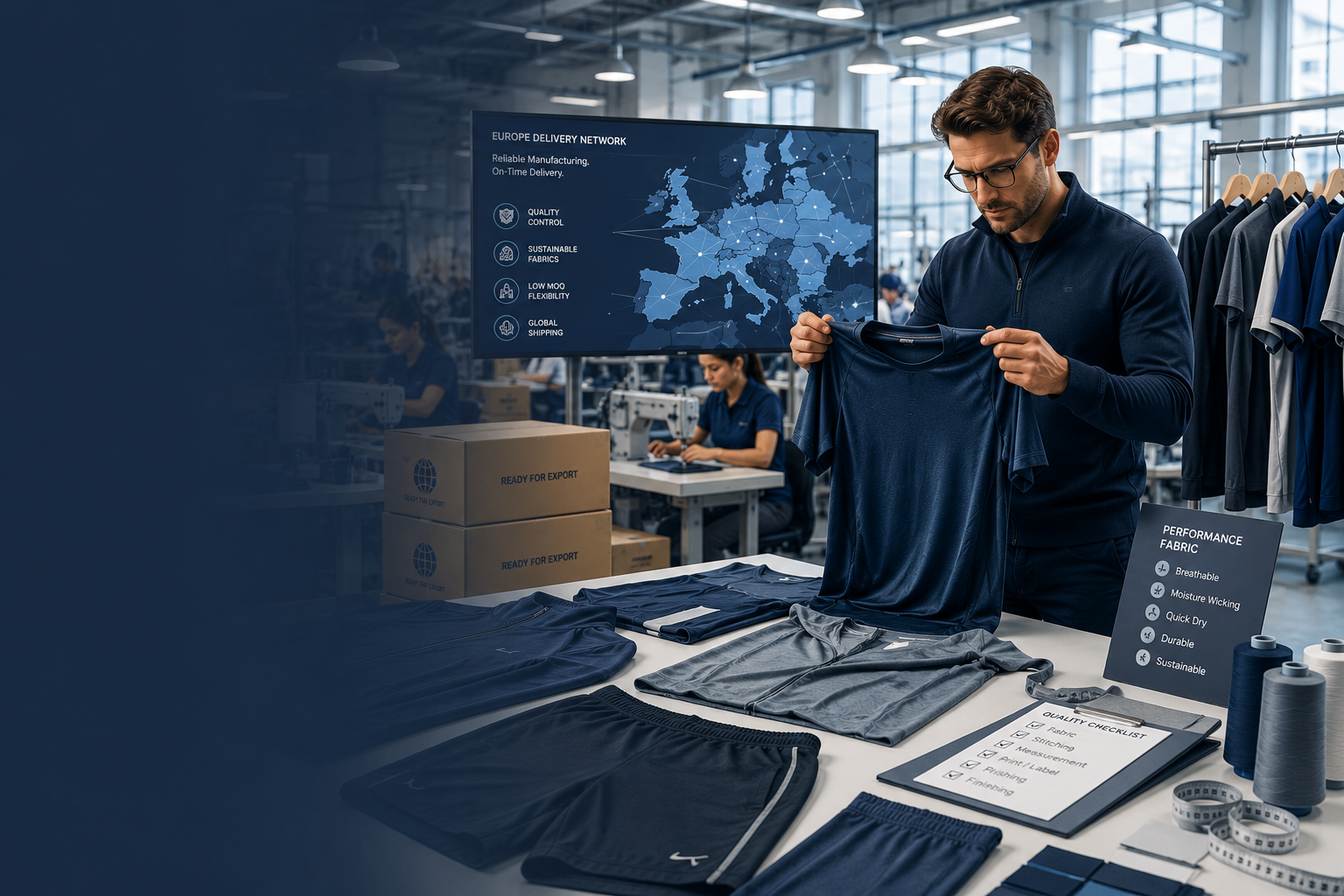
This one detail can save you real money and hassle. DDP means duties and VAT get paid before your order even leaves the factory, so there’s no surprise invoice waiting at customs — whether the factory is in Lithuania or Sialkot.
Do they actually answer your questions?
If replies are slow and vague before you’ve even placed an order, that pattern doesn’t magically fix itself once you have. How a manufacturer communicates at the enquiry stage is basically a preview of what it’s like working with them long-term.
Don’t Forget: Men’s and Women’s Fit Aren’t the Same Thing
Here’s something a lot of brand owners overlook: ask whether the manufacturer has real experience with women’s sizing specifically, not just a unisex block pattern relabelled. Leggings, sports bras, and fitted tops need their own pattern work, because the fit margin for error is much smaller than in loose unisex styles. If a manufacturer can’t speak to this directly, ask before you commit, not after your first batch arrives.
Questions to Fire Off Before You Commit to Anyone
- What’s your MOQ per style — and does it apply the same way to men’s and women’s lines?
- How long does a sample take, and does it cost anything?
- What fabric are you using, and can you show me certifications?
- Do you ship DDP into the EU, and which countries specifically?
- Once I approve a sample, what’s the real bulk production timeline?
- Can you show me examples of work you’ve done for brands like mine?
A manufacturer that answers these clearly, whether they’re sitting in Vilnius, Porto, or Sialkot is one worth taking seriously. One that dodges or goes vague is telling you something just as useful.
Frequently Asked Questions
What is the largest sportswear manufacturer in Europe?
There’s no single giant the way there is with sportswear brands. European sportswear manufacturing is spread across a lot of mid-sized, specialist factories across Portugal, Romania, Lithuania, and Italy, each usually focused on a particular product type or technique rather than one company dominating everything.
How do I find the best manufacturer for my clothing brand?
Figure out your priorities first — budget, order size, and how much EU-based production actually matters to you. Then shortlist a few manufacturers who offer real sampling, transparent fabric sourcing, and MOQs that fit your stage, and ask them all the same questions so you’re comparing like for like.
How do I start my own activewear brand?
Nail down your design and who you’re actually making it for first. Then find a manufacturer willing to work small — low MOQ and a real sample process matter far more here than anything else. Sample it, tweak it, confirm it, run a small first batch, then scale once you know it works.
What is the most popular sports brand in Europe?
Adidas and Puma, both founded in Germany, are still among the biggest and most recognised names with deep European roots, alongside a long list of smaller specialist brands that have built strong followings in specific sports like cycling, running, and football.
Should I pick a manufacturer in Lithuania, Portugal, or go overseas to somewhere like Pakistan?
Depends what matters most. EU-based options give you shorter shipping and production fully under EU rules, usually at a higher cost and higher MOQ. Overseas manufacturers, especially in an established hub like Sialkot, tend to cost less and let you order smaller quantities — as long as they handle shipping and customs properly, which is exactly what DDP shipping is for.
What does “high quality sportswear manufacturer” actually mean?
It means the fabric holds up, the sizing stays consistent across the whole run and not just the sample, and there’s a real inspection process before anything ships — not just a line on their homepage. Ask what standard they inspect against (AQL is the industry norm) and what happens if a batch fails it.
Comparing Your Options for European Sportswear Manufacturing?
At Warrco Industry, we make custom OEM and private-label sportswear for brands across Germany and the wider EU, out of our facility in Sialkot, Pakistan, one of the most established sportswear manufacturing hubs in the world. MOQs start at 20 pieces per style, every order goes through a real physical sample before bulk production, and we ship DDP straight into Europe, so nothing unexpected shows up at your border.
If you’re weighing EU-based versus overseas manufacturing for your brand, happy to walk you through exactly how we work and send fabric references before you decide on anything.